


Door Closer Types: Which Mounting Fits Your Opening?

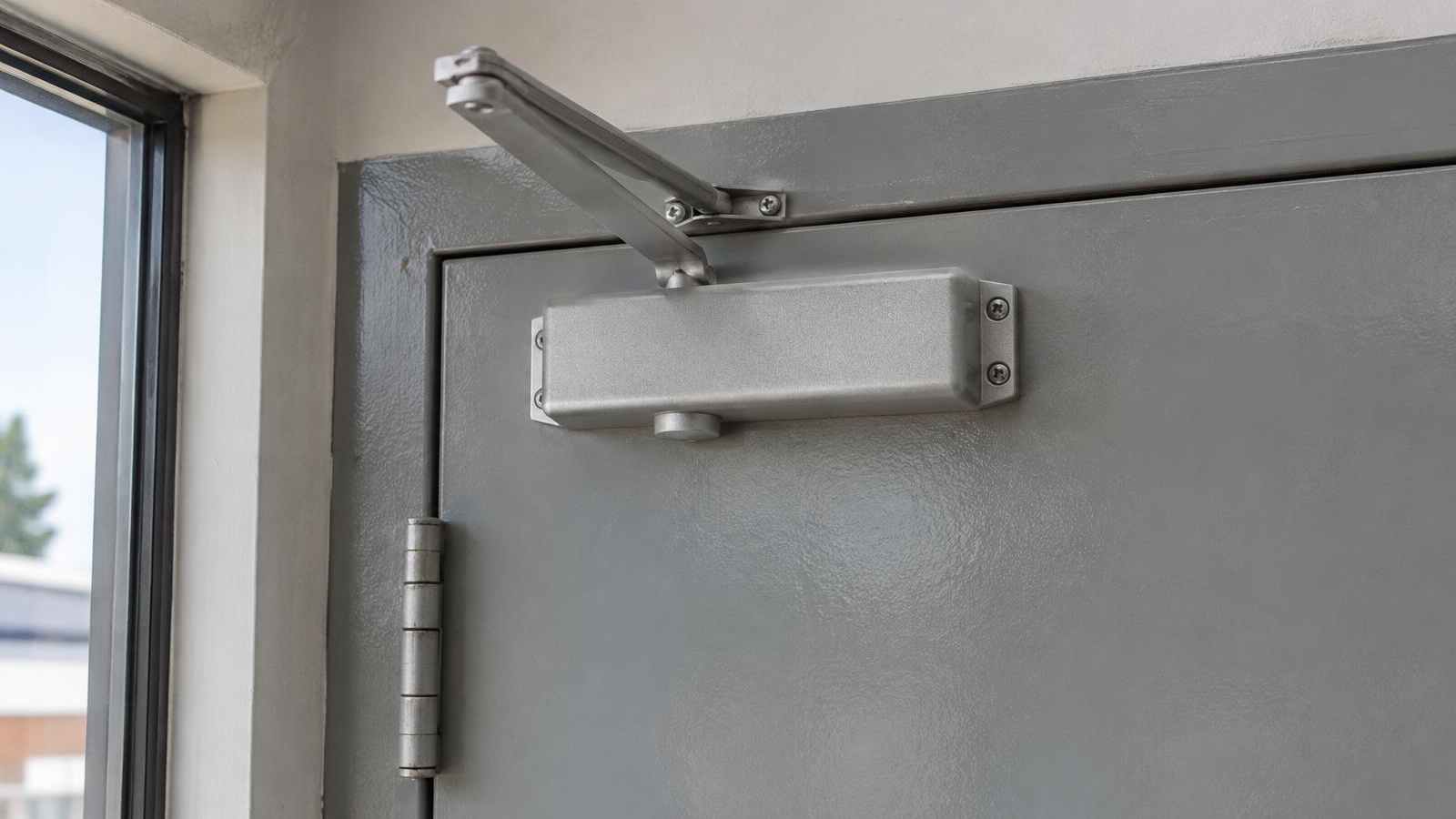
Door closer types differ first by where the mechanism sits: on the surface of the door or frame, concealed overhead or in the door, or recessed into the floor. For a surface closer, the mounting arrangement is a separate choice, with regular arm, top jamb and parallel arm configurations placing the body and arm differently. Start with the opening geometry rather than choosing by the cover's appearance.
Quick answer: Choose the closer location before the arm configuration. Check the push or pull side, space at the top of the leaf and frame, door swing, required functions and the manufacturer's mounting template. Surface, concealed and floor closers are not interchangeable simply because they close a door. For a Florida commercial specification, Mills & Nebraska has an Architectural Hardware Consultant on staff who can help coordinate the hardware selection with the opening requirements.
What door closer types should you compare?
Compare surface-mounted, concealed and floor-mounted mechanisms, then narrow the mounting and arm options within the selected family. The BHMA overview of ANSI/BHMA A156.4-2024 identifies surface closers, closers concealed in the door or overhead, and closers concealed in the floor within the standard's scope, along with pivots for floor closers.
A surface closer leaves its body visible on the door or frame. An overhead concealed closer hides the body in the frame head or the top of the door. A floor closer places the mechanism below the opening. These categories describe location, not a ranking from light to heavy duty.
If you are replacing hardware, identify the existing arrangement before comparing alternatives. For a new opening, ask the designer which hardware can remain visible and what space is available. Keep the closer category separate from the finish, arm function and performance requirements on your selection sheet.
How do regular arm, top jamb and parallel arm mounting differ?
Regular arm mounting puts the closer on the pull side of the leaf; top jamb mounting puts it on the push side of the frame; parallel arm mounting puts it on the push side of the leaf. The arm connects to a different surface in each arrangement, so the same-looking closer cover does not tell you whether the mounting will fit.
Allegion's LCN closer basics, revision January 2019, describes the mounting positions this way:
- Regular arm, also called hinge side mount: the body is on the pull side, with the arm attached above it to the frame face.
- Top jamb: the body is on the push side of the frame, with the arm connected to the door face.
- Parallel arm: the body is on the push side of the door, with the arm shoe attached underneath the frame head.
Use those locations to rule out arrangements that conflict with the opening. Choose the mounting from the opening detail and manufacturer's template. You still need the template, the arm option and a clear view of the frame detail.
What should you measure before ordering a surface closer?
Record the top rail, frame head, reveal and clearance through the intended swing. The top rail is the upper horizontal portion of the door leaf; the frame head is the horizontal frame member above it. The reveal is the setback between the relevant frame face and the door face, as shown on the manufacturer's mounting detail.
Measurements have to match the selected product's drawing. Allegion's official LCN 4040XP pull-side installation instructions, revision September 2017, provide a pull-side template for that closer. Check the selected mounting and arm configuration against its own instructions; this sheet is not a template for every closer or mounting arrangement.
For an existing opening, send photographs from both sides, including the frame above the leaf. For an unbuilt opening, provide the head detail and door elevation. Compare the closer template with the specified commercial door hinges, the stop and any other hardware occupying that space. Flag an unresolved fit question before selecting a substitute mounting.
When does a concealed or floor closer make sense?
Consider a concealed mechanism when the design calls for the body to be hidden, or a floor closer when an overhead closer cannot be used. Allegion's guide identifies concealed bodies in the frame head or door top and describes floor closers as an alternative for openings that cannot use an overhead closer.
That is a starting point for discussion, not permission to swap one family for another. Ask for the door and frame preparation details, the pivot arrangement where applicable, and access provisions for servicing. On a replacement, document the existing concealed hardware before deciding whether to retain the arrangement or redesign it.
Keep the opening's function in the conversation. A clean appearance does not answer how the door will operate, which arm or track is needed, or whether the specified mechanism can be accommodated. Request a complete configuration rather than a closer body alone.
Does a closer grade determine the correct mounting or duty level?
No. A test grade describes performance against the applicable standard, while mounting describes how the closer attaches to the opening. Allegion's explanatory guide cautions that specifying a grade alone does not define the desired closer level; it also discusses use frequency, appearance, features and functions as selection factors.
BHMA's overview identifies cycle, operational, closing force and finish tests, with additional optional tests specified separately. It is a summary of the standard, not the full standard or an approval of a particular opening. Keep the grade, mounting arrangement and intended use as distinct requirements in the specification.
Mills & Nebraska supplies commercial door closers, with LCN among the brands in its vendor lineup. Discuss the application rather than assuming every model from a listed manufacturer has the same arm choices or fits the same preparation. Describe traffic, exposure and the hardware functions the project needs without turning those details into an unsupported performance promise.
What is the difference between backcheck and latch speed?
Backcheck cushions the door near the end of its opening swing; latch speed controls the final part of closing. Allegion's guide distinguishes these functions and expressly warns that backcheck does not replace an auxiliary stop.
Resolve mounting compatibility separately from speed adjustment. If an existing door behaves poorly, record what happens during opening and closing separately and ask the appropriate service professional to assess the hardware and opening. This article is a selection reference, not valve-adjustment or repair instructions.
For a rated assembly, coordinate the closer and any holding function with the project's requirements and the manufacturer's listing. Include the relevant door and hardware documentation in that review. If sealing is also being specified, fire door gaskets addresses that component rather than substituting for closer selection.
What information should go to the hardware supplier?
Send an opening-specific description, not just a request for a silver closer. Include the door construction, dimensions, swing, preferred mounting side, frame detail, existing hardware where applicable, finish and required functions. Identify any accessibility or fire-rating requirements for the project team to review against the applicable documents.
Mills & Nebraska offers hardware specification services; send the opening information and closer requirements together for that review.
FAQs
Can one closer be mounted in more than one way?
A universal closer can support several mounting arrangements, while an application-specific closer is designed around a particular arrangement. Check the selected model's instructions and arm package before ordering. A universal body does not mean that every optional arm or accessory works in every mounting position.
Is a track arm the same as a parallel arm?
No. Allegion describes a track closer as using a single lever arm with a track on the door or frame, rather than a double-lever arm and shoe. Confirm whether the specified track application is push-side or pull-side, and use its own mounting details.
Can a replacement use the old closer's screw holes?
Check whether the holes match. Compare the existing preparation with the proposed model's template and fastening instructions, and record the door and frame materials. Ask the supplier to identify any mismatch before ordering, especially where the opening documentation limits modifications.
Should every door in a building use the same closer?
Standardizing a configuration can be a project preference, but review each opening before applying it throughout a building. Door and frame geometry, use conditions and required functions can differ. Document exceptions so a shared specification does not conceal an opening that needs another arrangement.
Contact Mills & Nebraska with the opening details for your closer selection.
Products and Services in This Article
- Exit Devices & Panic HardwareRim, vertical rod and mortise devices, including UL listed fire exit hardware.
- Commercial Door HingesBall bearing, continuous, swing clear and power transfer hinges.
- Commercial Door ClosersSurface, concealed and floor closers plus low-energy operators.
- Door Hardware SpecificationHardware consulting, scheduling and keying with an Architectural Hardware Consultant on staff.
Need Expert Guidance?
Our technical team is ready to help you navigate specifications, code requirements, and product selection for your project.