


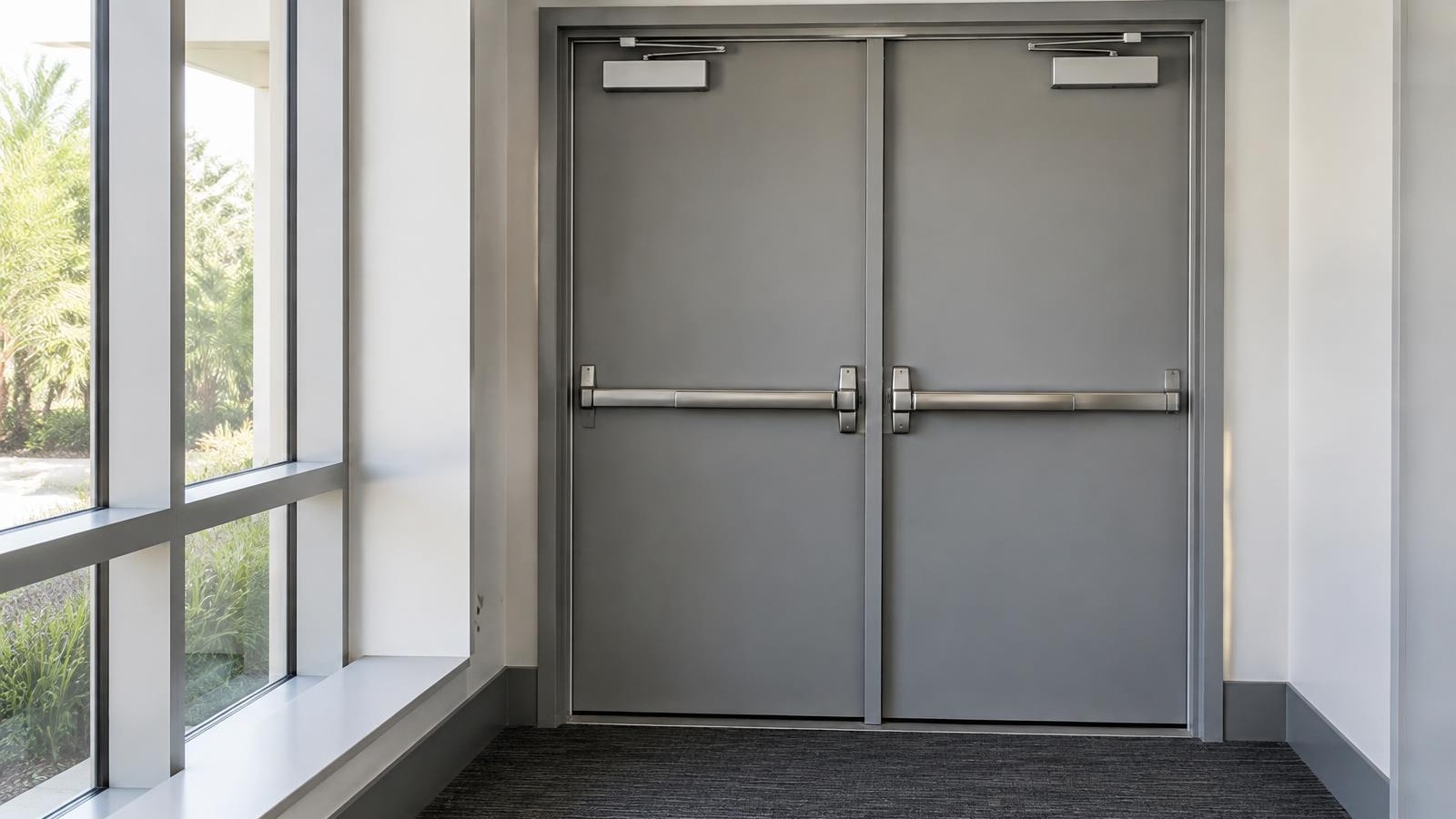
Fire Exit Hardware vs Panic Hardware: Listings and Dogging

Fire exit hardware vs panic hardware is a distinction in testing and permitted use, not simply in the appearance of a push bar. Fire exit hardware adds fire-door evaluation to panic performance and does not provide mechanical latch hold-back. Check the required opening configuration before accepting an exit device described only as a panic bar.
Quick answer: Confirm the device's listing and the opening's fire-rating requirement before comparing replacements. A familiar shape or an identical finish cannot establish fire-door suitability. Read the manufacturer's documentation for the complete configuration, including any latch-retraction option, rather than deciding from a photograph. Mills & Nebraska's Architectural Hardware Consultant supports specification questions, so bring the opening requirement and the proposed device description together for review.
Fire exit hardware vs panic hardware: what is the testing difference?
Panic testing evaluates emergency release; fire exit hardware also undergoes fire-door testing. Those evaluations address different conditions. An exit device is hardware with a bar or pad that operates the latch to permit exit, but the visible operating mechanism alone does not establish which testing applies.
UL's 2019 article on panic hardware and UL 305 explains that products intended for fire-door assemblies need additional evaluation under ANSI/UL 10C, Positive Pressure Fire Tests of Door Assemblies. It describes the resulting designation as fire exit hardware, deliberately distinguishing it from panic hardware regardless of outward appearance.
Use the actual listing information to identify the proposed device. The UL article describes fire testing that evaluates latch engagement and the integrity of the opening through fire and hose-stream testing. A catalog description of emergency release is therefore not equivalent to documentation of fire-door use.
This is a comparison of device classifications, not a determination that an opening needs panic hardware. Have the responsible designer establish that requirement and any applicable fire rating. The two questions belong together, but neither should be answered by a generic request for an exit bar.
Why does mechanical dogging matter?
Mechanical dogging holds the latch retracted so the door can operate without latching on each use. It is not the same thing as holding the door leaf physically open. That distinction matters when reviewing a requested push/pull operating mode.
Allegion's panic-versus-fire-exit explanation, published July 2012 describes dogging as retaining the latch with a key or tool. It states that fire exit hardware cannot use mechanical dogging because the fire door must positively latch. UL's 2019 article likewise excludes mechanical latch hold-back from fire exit hardware.
If the quote includes a hold-back feature, ask exactly what it does and which configuration is being proposed. Check the documented use of that key-operated control on the selected device. The requested operation and the listed device need to be reviewed together.
For an existing opening, record how the hardware is currently used without treating that usage as evidence of approval. A door that has been operating in a convenient mode may still need review against its documentation. Have a qualified service professional identify the hardware.
Is electric latch retraction the same as mechanical dogging?
No. Electric latch retraction uses powered hardware to withdraw the latch; its permitted use on a fire-door assembly depends on the appropriate release and latching arrangement. Confirm the permitted electrical configuration separately.
Allegion's July 2012 explanation describes electrical operation as an option when the latches project automatically upon fire alarm. Treat that statement as the condition attached to the explanation, not a promise that any device with wires provides the required response. Request the selected manufacturer's listed configuration and instructions for the project review.
Describe what the opening must do during ordinary use and under the relevant alarm condition. Ask who is responsible for confirming the device, controls and intended sequence. If those details are unresolved, mark them as open questions instead of selecting a replacement based solely on the desired push/pull convenience.
A closer and an exit device are separate parts of that review. Document the specified commercial closer alongside the latch-retraction request. Confirm closing operation and the exit device's listing separately.
Does every fire-rated opening need an exit device?
The fire rating alone does not answer that question. Establish whether the opening calls for panic-type release and then select the appropriate hardware for that requirement. Select the hardware for each opening's documented requirements.
The broader fire-rated openings information addresses assemblies rather than treating a rating as a standalone product. Keep the proposed device tied to the door and frame documentation. Ask the project designer to resolve any disagreement between the hardware description and the specified opening.
Avoid using a room name as the entire selection rule. A classroom, corridor or service-room description can provide context, but it does not document all of the conditions that the designer must evaluate. Confirm the applicable occupancy and code requirements for the project.
For broader hardware coordination, the article on commercial hardware for doors describes the components around the lock and exit device. Use this comparison to resolve the classification question without replacing that wider opening review.
What should you send when ordering or replacing an exit device?
Mills & Nebraska supplies exit devices, and its exit-device product page is the relevant supply destination. Identify what is requested and what is proposed as a substitute, rather than treating two similar bars as an accepted match. Keep the operating feature and listing information with the opening mark.
Consider including the following in the request:
- Opening identifier and the project requirement for the device.
- Door and frame information, including the specified fire rating where applicable.
- Manufacturer, model and listing documentation for the proposed configuration.
- Photographs and identifying information for existing hardware, if being replaced.
- Requested latch behavior and any powered release arrangement.
- Details that remain unresolved or require approval before ordering.
A finish, overall length or mounting pattern may help identify an existing item, but do not use those details as substitutes for its documented classification. Ask the supplier to name any differences in the proposed replacement. Retain the answer with the order so the change is visible to the reviewer.
How should a hardware substitution be documented?
Document the proposed classification and operating differences explicitly. Identify which opening is affected, what the specification requests and what the alternative changes. If the information is incomplete, request clarification rather than describing the substitution as equivalent.
For hardware specification assistance, send the relevant device description and supporting manufacturer literature together. A reviewer should be able to compare the requested and proposed configurations without reconstructing the question from unrelated photographs or a shortened product name.
Keep approval separate from identification. Recognizing an existing brand or finding a similar catalog image is a starting point for discussion, not authorization to change the opening. Resolve the listed use and requested operating sequence before accepting the alternative.
FAQs
Can two similar push bars have different listings?
Yes. UL's explanation expressly distinguishes fire exit hardware from panic hardware regardless of outward appearance. Confirm the specific device designation and documentation, not just the cover shape. If a replacement looks identical, ask whether its listed use and operating options also match what the opening requires.
Does a fire-exit device establish the rating of the whole opening?
The device designation addresses only that component. Review the door, frame and hardware documentation together against the project requirement. Confirm the documented rating of the proposed combination.
Can a hold-open request mean different things?
Yes. Ask whether the request concerns retaining the latch or keeping the leaf physically open. Those are different operating questions. Describe the intended behavior plainly and have the reviewer compare it with the selected hardware's documentation, rather than using hold open as an unexplained order note.
Is removing a dogging feature enough to convert existing hardware?
A field alteration does not establish another listing. Request the manufacturer's guidance for the identified device and proposed use. If the project needs a different classification, have that requirement resolved through the appropriate documented configuration rather than treating a removed part as evidence of fire-door suitability.
Contact Mills & Nebraska with the opening requirement, device documentation and any proposed substitution for your commercial exit-hardware request.
Products and Services in This Article
- Fire-Rated Doors & FramesFire-rated doors and frames from Mills & Nebraska in Orlando, FL: hollow metal, wood and fiberglass assemblies rated 20 minutes to 3 hours, labeled in house.
- Exit Devices & Panic HardwareRim, vertical rod and mortise devices, including UL listed fire exit hardware.
- Commercial Door HingesBall bearing, continuous, swing clear and power transfer hinges.
- Commercial Door LocksGrade 1 cylindrical and mortise locksets, keying and electrified options.
Related Articles
Need Expert Guidance?
Our technical team is ready to help you navigate specifications, code requirements, and product selection for your project.