


Mortise Lock vs Cylindrical Lock: Which Commercial Lockset Fits Your Opening?

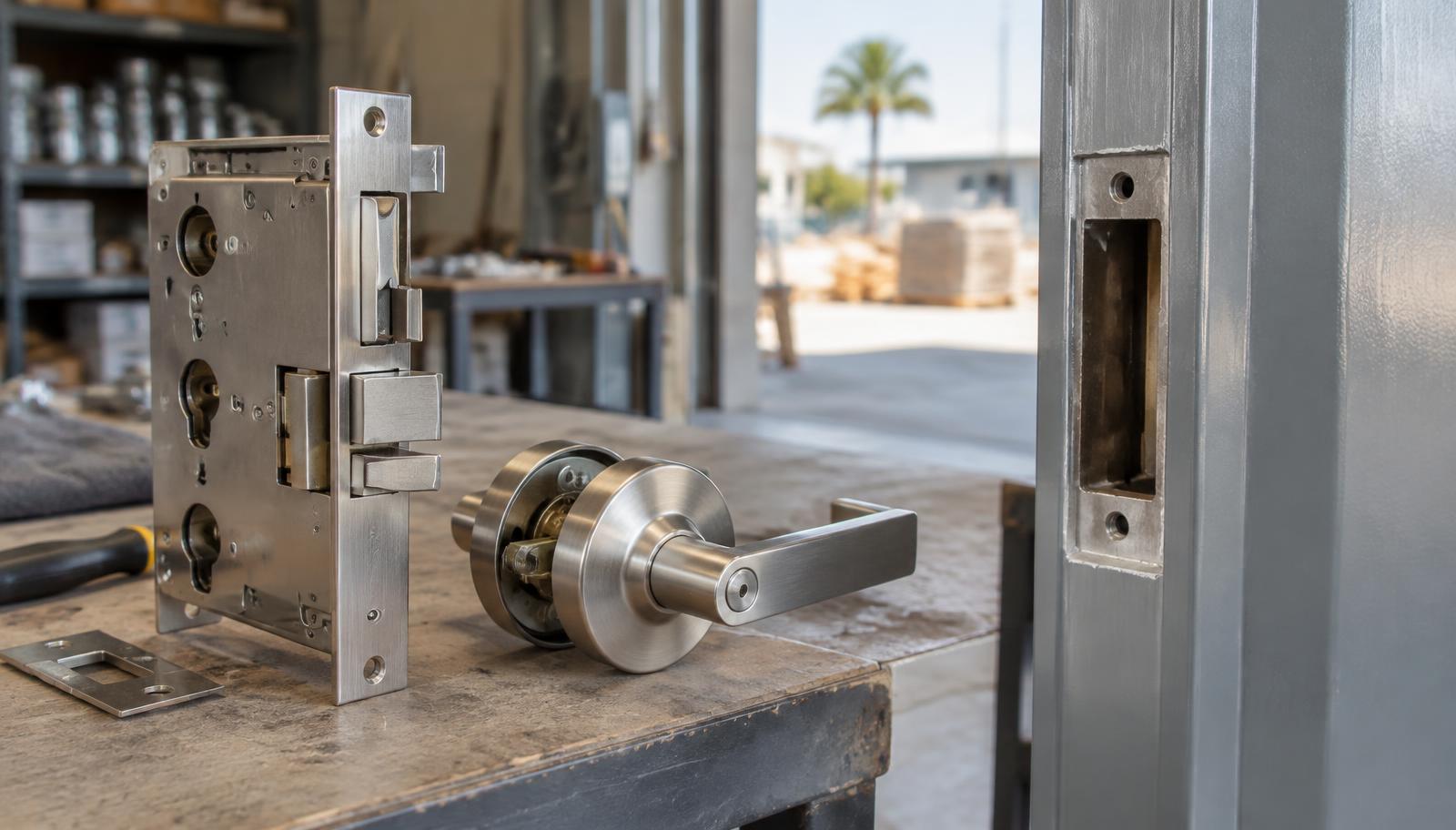
The main difference between a mortise lock vs cylindrical lock is how the lock body fits in the door. A cylindrical lock, also called a bored lock, installs through two round holes, one through the door face and one in the door edge, while a mortise lock sits in a rectangular pocket cut into the door edge. Cylindrical locks are the standard for most commercial offices, classrooms and corridors, and mortise locks are chosen for hospitals, hotels, government buildings and other openings that see the heaviest use or need more lock functions.
Quick answer: Choose a Grade 1 cylindrical lock for standard commercial traffic, quick installation and easy service, and a mortise lock where you need the most durability, the widest choice of functions or the strongest security. Grade 1 versions of both must pass a one million cycle BHMA test. Mills & Nebraska stocks cylindrical and mortise locksets at its Orlando and Lakeland locations, and its Architectural Hardware Consultant specifies the grade and function for every opening.
What is a mortise lock?
A mortise lock is a lockset whose working parts sit inside a rectangular steel case, called the lock body, that fits into a pocket cut into the edge of the door. The levers, key cylinder and thumbturn attach through holes in the door faces and operate the latch, and on many functions a deadbolt, inside that case.
Mortise locks are covered by the ANSI/BHMA A156.13 standard. Because the case is large and sits within the door, a mortise lock has room for more mechanisms, which is why mortise models offer the broadest range of functions, from storeroom and classroom locks to apartment, dormitory and hotel guest room functions.
The trade off is the door prep. The pocket must be cut accurately in the door edge, and steel doors are reinforced at the factory for the specific lock. A mortise lock usually costs more per opening than a cylindrical lock and takes longer to install.
What is a cylindrical lock?
A cylindrical lock, or bored lock, is a lockset built as one assembly that slides through a large round hole bored through the door and connects to a latch installed in a smaller hole in the door edge. The lever, rose and cylinder sit on the door faces, and the mechanism lives in the round chassis between them.
Commercial cylindrical locks are covered by the ANSI/BHMA A156.2 standard for bored and preassembled locks. The distance from the door edge to the center of the bore is called the backset. The commercial door locks Mills & Nebraska supplies use a 2-3/4 inch backset as standard, with 2-3/8 inch available.
Cylindrical locks install quickly, are easy to swap during service and come in all the common ANSI functions, including passage, privacy, office, storeroom and classroom security. That combination makes them the default lock for most commercial interior doors.
Mortise lock vs cylindrical lock: what are the key differences?
The two lock types differ most in installation, functions and security, and they are closer than many people expect on durability.
- Installation: a cylindrical lock needs two round bores, while a mortise lock needs a rectangular edge pocket plus face holes for the trim. Steel doors arrive prepped for one or the other.
- Durability: Grade 1 locks of both types must pass one million cycles of opening and closing with a 10 pound load, according to the BHMA summary of A156.2.
- Security: the BHMA summary of A156.13 lists fifteen security tests for mortise locks, compared with seven for bored locks. Both standards include a 1,200 in-lbf locked lever torque test.
- Functions: mortise locks offer the widest range, including functions that combine the latch and a deadbolt in one case. Cylindrical locks cover the common commercial functions.
- Service: a cylindrical lock can be replaced as one unit. A mortise lock is repaired inside the case, and a replacement should match the existing prep.
- Cost: cylindrical locks usually cost less per opening and take less labor to install.
Which is more secure, a mortise lock or a cylindrical lock?
A mortise lock is generally the more secure choice, because its steel case sits inside the door and the BHMA mortise standard sets more than twice as many security tests as the bored lock standard. For records rooms, pharmacies, secure offices and other restricted spaces, mortise is a common specification.
A Grade 1 cylindrical lock is still a strong commercial lock that passes the same locked lever torque test. In practice, keying matters as much as the lock body. Mills & Nebraska supplies restricted and patented keyways, small format and large format interchangeable cores (SFIC and LFIC), and master key system design, so the key a person carries limits where they can go.
When should you choose a cylindrical lock?
Choose a cylindrical lock for standard commercial traffic where fast installation and easy replacement matter most. Mills & Nebraska supplies Grade 1 cylindrical locks as the workhorse lock for Florida schools, offices and multifamily corridors.
Typical openings include offices, conference rooms, storerooms, classrooms and apartment unit entries. For multifamily, interconnected locks retract the latch and the deadbolt in a single motion for apartment egress. Classroom security functions let a teacher lock the door from inside the room.
When should you choose a mortise lock?
Choose a mortise lock for doors that cycle constantly, need special functions or protect restricted spaces. Mills & Nebraska specifies mortise locks for hospitals, hotels and government buildings, where locks see heavy daily use and functions are more specialized.
Common examples are patient room and clinical doors in healthcare facilities, hotel guest room and service doors, dormitories and government offices with restricted keyways.
Can you replace a cylindrical lock with a mortise lock?
Yes, but usually not by swapping the lock alone, because the door needs a mortise pocket and the correct reinforcement. On a steel door prepped for a bored lock, the common options are a new door prepped for mortise or a door modification done to the manufacturer's template.
Going the other way, replacing a mortise lock with a cylindrical lock, leaves an empty pocket that must be filled or covered. On a fire-rated door, any new cut or modification must be allowed under the door's label, so check before you order. Mills & Nebraska preps doors in house and has in-house Intertek-certified fire labeling, so a rated door it modifies can leave the shop labeled.
What do ADA and fire codes require of commercial locks?
Both lock types can meet accessibility and fire requirements when the right trim and listing are specified. Under the 2010 ADA Standards, door hardware must be operable with one hand without tight grasping, pinching or twisting of the wrist, and must be mounted 34 to 48 inches above the finish floor. That is why commercial locks use lever trim instead of knobs. BHMA testing also caps the torque to open a lever lock at 28 in-lbf.
For fire-rated doors, the lock must be listed for the rating of the opening. The cylindrical and mortise locks Mills & Nebraska supplies are UL listed up to 3 hours. See fire-rated openings for how rated assemblies are built, and the ADA door requirements guide for widths, clearances and opening force.
How Mills & Nebraska specifies commercial door locks
Mills & Nebraska supplies Grade 1 and Grade 2 cylindrical and mortise locksets from Schlage, Corbin Russwin and SARGENT, along with interconnected locks, deadbolts and lever trim. You can see the full range on the commercial door locks page.
- Stock: cylindrical and mortise locksets are stocked at the Orlando and Lakeland locations, with Same Day lead times on stocked items.
- Specification: the on-staff Architectural Hardware Consultant matches the lock type, grade and ANSI function to each room through hardware specification.
- Electrified options: both lock types are available electrified, with fail-safe or fail-secure operation, request-to-exit signaling and latch monitoring for access control.
- Keying: new cylinders are keyed to your existing master key system, or a new system is designed from scratch.
For how locks fit with hinges, closers and exit devices on the same opening, see commercial door hardware for secure, code compliant openings.
FAQs
Is a mortise cylinder the same as a mortise lock?
No. A mortise cylinder is the threaded key cylinder that screws into the lock case and is turned by the key to lock or unlock. The mortise lock is the complete assembly: the case, the latch and bolt, the trim and the cylinder. Interchangeable core cylinders are specified with the lock so the keying matches the rest of the building.
Are mortise locks a standard size?
Not entirely. Mortise lock cases from different manufacturers are similar, but the case size and trim hole patterns are not always the same. A replacement should match the existing brand and series, or the door should be prepped to the new lock's template. That is why the hardware schedule names the exact lockset before steel doors are ordered.
Are commercial cylindrical locks Grade 1?
Most commercial cylindrical locks on busy doors are specified as BHMA Grade 1, the highest grade, which must pass a one million cycle test. Grade 2 is used on lighter duty interior doors. Mills & Nebraska supplies both Grade 1 and Grade 2 locksets, and its Architectural Hardware Consultant matches the grade to how hard each door is used.
Can cylindrical and mortise locks share one master key system?
Yes. Cylindrical and mortise locks in the same building can run on one master key system when their cylinders use the same keyway. Mills & Nebraska designs master key systems, keys new cylinders to existing systems, and supplies small format and large format interchangeable cores so a facility can rekey without replacing the locks.
Request a quote from Mills & Nebraska with your door and hardware schedule, and our Florida team will confirm the lock type, grade, function and keying for every opening.
Products and Services in This Article
- Fire-Rated Doors & FramesFire-rated doors and frames from Mills & Nebraska in Orlando, FL: hollow metal, wood and fiberglass assemblies rated 20 minutes to 3 hours, labeled in house.
- Commercial Door LocksGrade 1 cylindrical and mortise locksets, keying and electrified options.
- Exit Devices & Panic HardwareRim, vertical rod and mortise devices, including UL listed fire exit hardware.
- Commercial Door HingesBall bearing, continuous, swing clear and power transfer hinges.
Related Articles

Need Expert Guidance?
Our technical team is ready to help you navigate specifications, code requirements, and product selection for your project.