


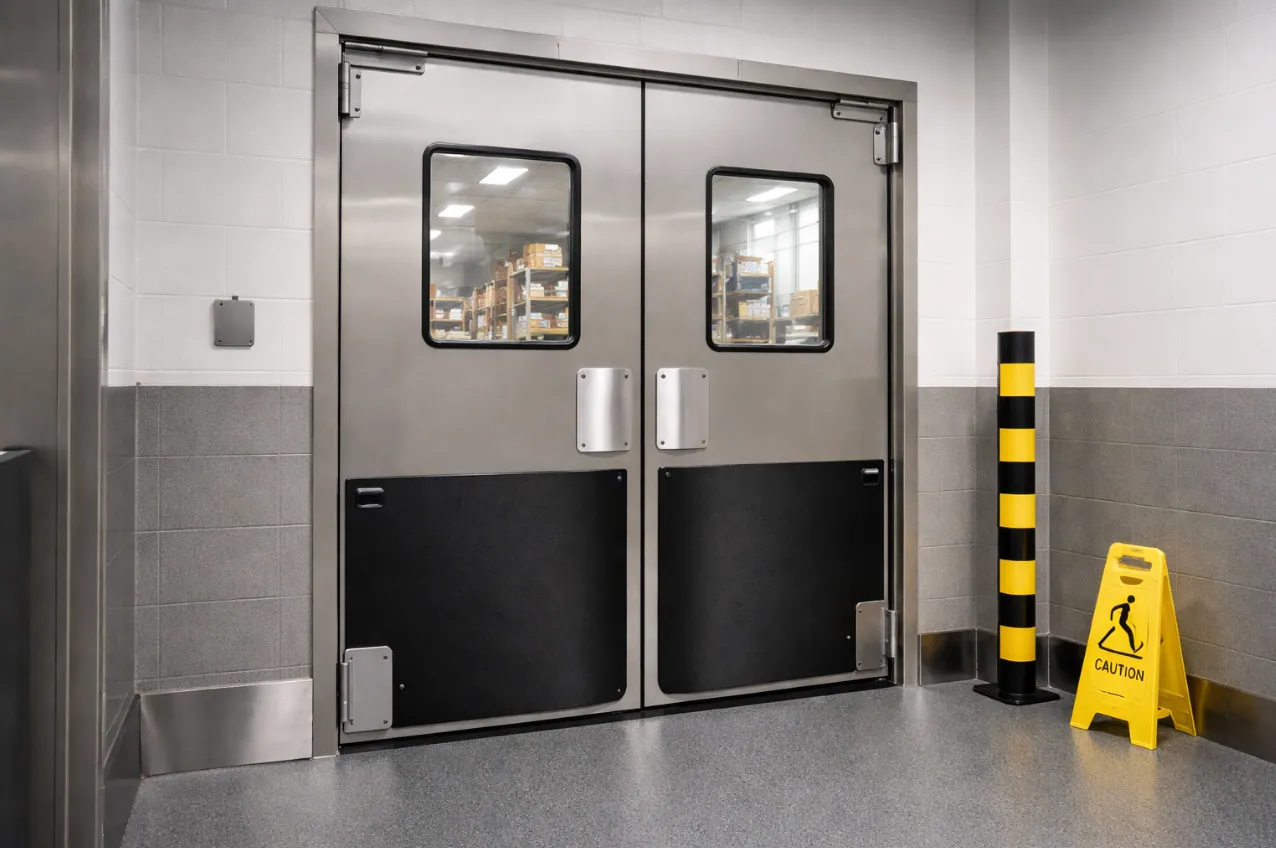
Impact Rated Commercial Doors Fabricated and Supplied for Florida Projects

Impact rated commercial doors are complete door, frame, and hardware assemblies tested to resist wind-borne debris impact and cyclic wind pressure. In Florida they are used on exterior openings where the Florida Building Code, 8th Edition (2023), requires impact resistance, and they must carry Florida Product Approval (or local approval). In the High-Velocity Hurricane Zone (Miami-Dade and Broward counties), the approval must cover HVHZ use, such as a Miami-Dade Notice of Acceptance (NOA) or a Florida Product Approval approved for the HVHZ.
From healthcare facilities to warehouses and mixed-use developments, these doors help protect occupants, maintain building integrity, and meet inspection standards during hurricane conditions. Mills & Nebraska supplies impact rated doors for Florida commercial projects and helps teams match each door assembly to its approval, performance, and durability requirements.
Why Impact Rated Commercial Doors Are Essential in Florida Construction
Florida's Hurricane Zones and Wind-Borne Debris Risks
Florida construction must account for extreme wind pressure and wind-borne debris generated during hurricanes and tropical storms. Impact rated doors are designed to resist flying debris, including metal, wood, and glass fragments, that can compromise standard openings during severe weather.
Unlike standard commercial doors, impact doors are tested to withstand a wind-borne debris impact followed by thousands of cycles of positive and negative pressure. This level of impact resistance helps prevent failure at the wall opening, which is often one of the most vulnerable points during a storm.
How Impact Rated Doors Protect Occupants and Building Integrity
When an exterior opening fails, internal pressurization can lead to roof loss, wall damage, and widespread structural damage. Impact rated doors help maintain the building envelope by resisting breach under pressure and debris impact.
Whether constructed from steel, stainless steel, fiberglass, or reinforced metal assemblies, these doors are engineered as part of a complete rated system, including the frame, hinges, and anchoring method, to protect both occupants and assets inside the building. Our hurricane doors resource explains how these systems are tested and approved.
The Cost of Using Non-Compliant Door Assemblies
Using non-rated or incorrectly assembled door systems where impact protection is required can result in failed inspections, delayed occupancy, costly retrofits, and insurance issues. Properly specified impact rated doors help contractors avoid these risks by addressing compliance from the start.
What Makes a Commercial Door Impact Rated
Impact Testing Standards and Certification Requirements
Impact rated commercial doors must pass standardized testing that simulates hurricane conditions. In the High-Velocity Hurricane Zone, products are tested to TAS 201 (wind-borne debris impact), TAS 202 (uniform static air pressure), and TAS 203 (cyclic wind pressure). Outside the HVHZ, products are commonly tested to ASTM E1886 and ASTM E1996. These tests evaluate both debris impact and cyclic pressure loading to confirm the door's performance under sustained wind forces.
Door, Frame, and Hardware as a Complete Rated Assembly
An impact rated door is not just a slab. It is a complete system. The door, frame, hinges, anchors, and hardware must all match the tested assembly. Mixing components, even if each part appears "rated" individually, can invalidate the approval.
Differences Between Impact Rated and Standard Commercial Doors
Standard commercial doors are designed for daily use, fire protection, or security, but not necessarily for impact resistance. Impact rated doors typically use reinforced construction, heavier-gauge steel or fiberglass skins, laminated impact glazing where glass is included, and enhanced frame anchoring.
Florida Building Code Requirements for Impact Rated Commercial Doors
Florida Product Approval and Miami-Dade Compliance
Impact rated doors used in Florida must carry the appropriate approval documentation: Florida Product Approval (or local product approval) statewide, and, for projects in Miami-Dade and Broward counties, a Miami-Dade NOA or a Florida Product Approval approved for use in the HVHZ. See our Florida Building Code resource for more on approvals.
Wind Load, Pressure Ratings, and Opening Size Considerations
Impact rated doors are approved for specific conditions, including maximum opening height and width, design pressure, swing direction, and wall construction. The approved design pressure must meet or exceed the building's calculated design pressure at that opening.
Inspection, Documentation, and Labeling Requirements
Inspectors rely on visible labels, approval numbers, and supporting documentation to verify compliance. Missing or incorrect labels, altered hardware, or undocumented substitutions can cause rejection during inspection.
Types of Impact Rated Commercial Doors Used in Florida
Hollow Metal and Steel Impact Rated Doors
Hollow metal doors and steel impact rated doors are widely used for exterior openings, service areas, and high-exposure locations. Their reinforced metal construction provides strong impact resistance and durability under repeated pressure cycles.
Impact Rated Doors for Exterior and High-Exposure Openings
Exterior openings exposed to direct wind and debris impact often require impact rated doors with reinforced frames, heavy-duty hinges, and tested anchoring systems.
Custom Impact Rated Door Solutions for Non-Standard Projects
Not all projects fit standard openings. Unique wall conditions, oversized openings, or architectural designs may call for custom configurations, which must still fall within the limits of an approved, tested assembly.
Common Mistakes with Impact Rated Commercial Doors
Mixing Non-Rated Components in Rated Openings
One of the most common and costly mistakes in impact rated construction is mixing rated and non-rated components. An impact rated door slab paired with a non-rated frame, hinge set, or anchoring method can invalidate the entire assembly.
Improper Frame Anchoring or Wall Conditions
Impact resistance depends heavily on how forces are transferred into the surrounding wall. Frames must be anchored exactly as specified in the approval and matched to the correct wall type.
Missing or Incorrect Approval Documentation
Florida inspectors require clear proof that impact rated doors meet code. Missing Florida Product Approval numbers, outdated documentation, or unreadable labels can stop a project.
How Mills & Nebraska Supports Impact Rated Door Projects
Code-Compliant Fabrication and Product Sourcing
Mills & Nebraska works with contractors, architects, and facility managers to supply impact rated commercial doors that meet Florida Building Code and local jurisdiction requirements.
Florida Supply and In-House Labeling
With warehouses in Orlando and Lakeland, same-day stock availability, and in-house Intertek-certified labeling for fire and wind, Mills & Nebraska helps keep impact rated openings moving on Florida schedules.
Contractor Support, Submittals, and Inspection Readiness
Mills & Nebraska assists by providing approval documentation, labeling guidance, and technical support to help teams prepare for plan review and field inspection.
FAQs
What are impact rated commercial doors?
Impact rated commercial doors are door assemblies tested to withstand wind-borne debris and pressure cycles during severe weather. They are designed to protect buildings during hurricanes and meet Florida Building Code requirements.
Are impact rated doors required for all Florida commercial buildings?
No. Requirements depend on the building's location and design wind speed, whether the site is in a wind-borne debris region or the High-Velocity Hurricane Zone, the opening type, and the building's use. The design professional of record determines which openings need impact protection.
Can impact rated doors include glass or louvers?
Yes, but only when those components are part of an approved, tested assembly. Impact glazing or louver configurations must be specifically listed in the door's approval documentation.
Do impact rated doors need special frames and hardware?
Yes. Impact rated doors must be paired with compatible frames, hinges, anchors, and hardware exactly as tested. Mixing components can void the rating.
Request a quote or contact Mills & Nebraska to discuss impact rated door solutions for your next commercial project.
Products and Services in This Article
- Hurricane-Rated & Windstorm-Resistant Doors and FramesHurricane-rated, windstorm resistant doors and frames with Miami-Dade NOA or Florida Product Approval, labeled in house by Mills & Nebraska in Orlando, FL.
- Standard Welded FramesFactory-welded frames fabricated in Orlando for new construction.
- Knock-Down FramesFrames that ship in pieces and assemble on site for renovations.
- Security FramesReinforced frames with anti-pry features and detention-grade options.
Related Articles

Need Expert Guidance?
Our technical team is ready to help you navigate specifications, code requirements, and product selection for your project.